
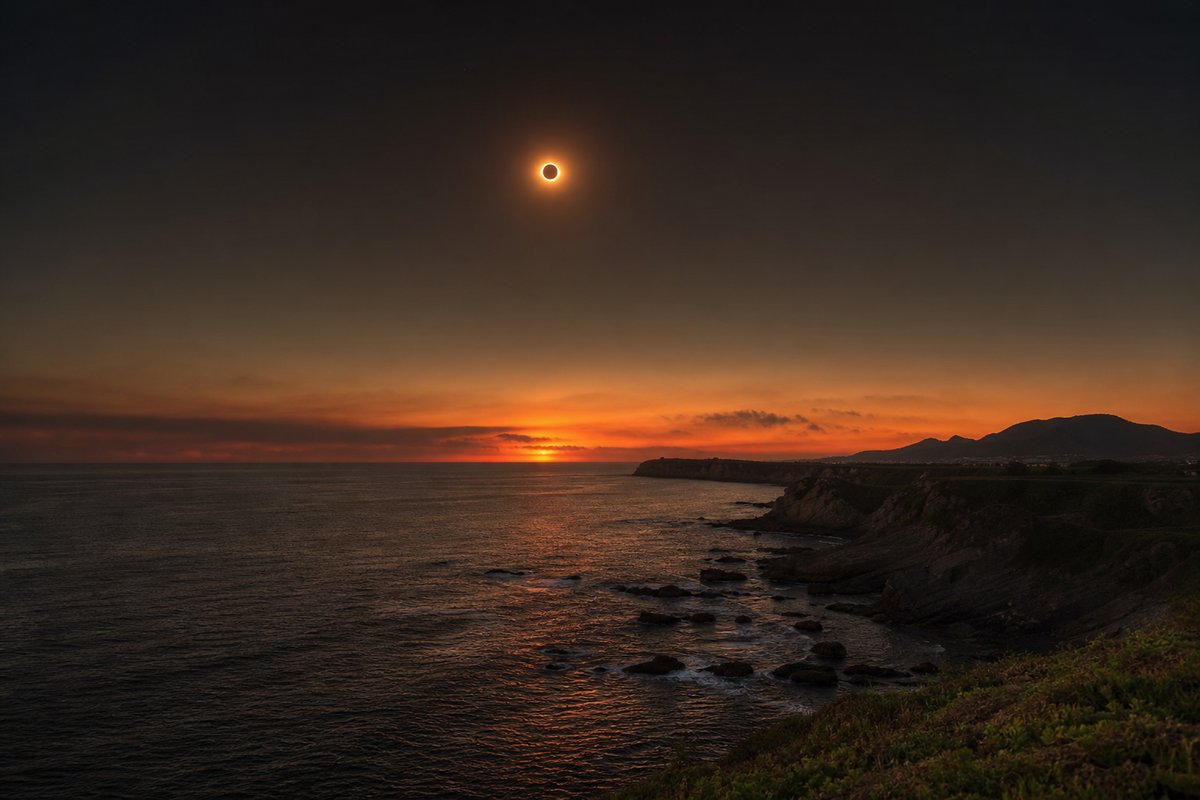
Spain is set for an unusual celestial event on August 12, 2026, when a total solar eclipse will pass across the north of the country for the first time in more than a century. According to the report, the path of totality will sweep from Galicia across central Spain and on toward the Mediterranean and the Balearic Islands, covering roughly 40% of the country. Among the places expected to see totality are A Coruña, Bilbao, Zaragoza, and Valencia, while Madrid and Barcelona will experience a partial eclipse of 99%.
What makes this eclipse especially distinctive is its timing. Rather than appearing high overhead at midday, it will unfold close to sunset, with totality expected between about 8:26 p.m. and 8:32 p.m. local time. That lower position in the sky could increase the chance of seeing the “diamond ring” effect, when sunlight briefly shines around the moon’s edge. At the same time, the report notes that a clear western horizon will matter more than scenic elevation, since hills, trees, and buildings could block the view.
Where to watch the eclipse in Spain
Coastal locations are likely to offer some of the best viewing conditions. In Galicia, Cape Ortegal is expected to be among the longest-lasting totality points, while A Coruña’s Tower of Hercules and Monte de San Pedro park are also highlighted for their open Atlantic outlooks. In Cantabria, El Puntal beach near Santander and Playa de Langre are presented as strong options because of their broad west-northwest views over the water. On the Mediterranean side, the report says a boat may be the safest way to get an unobstructed sightline, especially in Valencia, where La Malvarrosa beach faces east. Several boating operators there are offering eclipse-viewing charters.
Among the Balearic Islands, Mallorca, Menorca, and Ibiza will fall within the path of totality, while Formentera will see a partial eclipse instead. The report also notes that this year’s event coincides with the Perseids meteor shower, and the darker post-sunset sky could improve viewing conditions for that as well. Travelers planning to watch should bring ISO 12312-2 certified eclipse glasses and be prepared for large crowds across Spain, especially in smaller destinations.
Source: cntraveler.com